

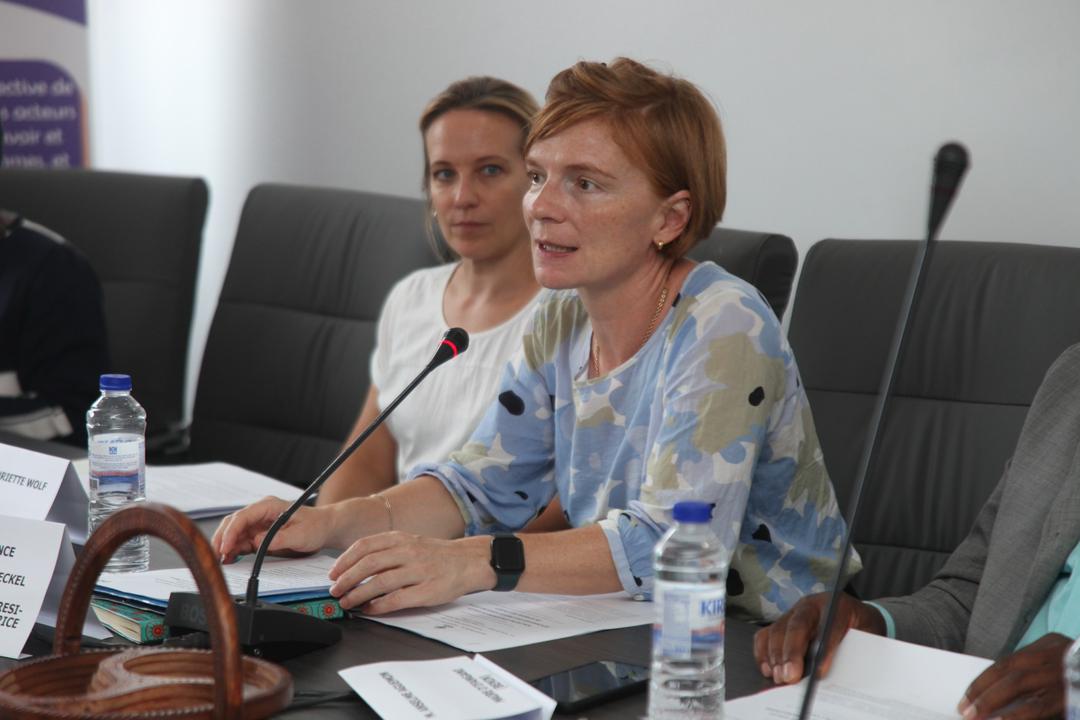
By Mrs Henriette Wolf, First Secretary (Political) at the Embassy of the Federal Republic of Germany in Dakar
Dakar — At a closed-door convening hosted on Tuesday by the Réseau des Femmes Leaders pour le Développement (RFLD) at its Dakar Office, the most consequential intellectual claim of the afternoon was not advanced by a State actor, by a bilateral cooperation partner, or by a multilateral agency. It was advanced by a Senegalese jurist whose three-decade engagement with the African human rights system has earned him senior expert status on the continent.
Professor Mabassa Fall told the room that the African human rights system is not under-developed in instruments. It is under-developed in the mechanisms by which civil society — and women defenders specifically — can convert continental decisions into national protection.
The claim is strategically consequential. It reframes the dominant narrative about continental human rights governance in Africa, which has tended to emphasise the gaps in the normative architecture as the principal challenge. Professor Fall’s reading inverts that narrative: the corpus is sufficient. The Charter is there. The Maputo Protocol is ratified by a substantial number of States parties. The ACHPR Resolutions 522 on women’s digital rights and 596 on women defenders extend and operationalise the commitments made by States in the Maputo Protocol. The Reprisals mandate exists. The Working Group on Human Rights Defenders functions. What is missing is the operational accompaniment — the architecture by which the corpus reaches the defender in Bamako, in Ouagadougou, in Niamey, in Conakry.
The intellectual stakes of this reframing are substantial for several reasons.
First, it shifts the strategic question facing African States parties to the African Charter on Human and Peoples’ Rights. If the corpus is sufficient, then the conversation about continental human rights governance shifts from norm-creation to norm-implementation. The political economy of implementation differs from the political economy of norm-creation. Norm-creation produces declarations, summit statements, ratifications. Norm-implementation requires the unglamorous, technically difficult, politically sensitive work of operational accompaniment — the building of mechanisms by which a continental decision can be invoked at country level by the actors whose lives it is supposed to protect.
Second, the reframing has direct implications for the donor architecture that accompanies African States in their human rights commitments. The European bilateral cooperation present in Dakar on Tuesday — the Kingdom of Sweden represented by Ambassador Catharina Cappelin, the Federal Republic of Germany represented at three levels through Mrs Henriette Wolf at the Embassy, Mrs Katja Roeckel at GIZ Senegal as Country Director — has historically been organised around two principal modalities: support to State institutions of African partners, and support to multilateral mechanisms. The operationalisation gap thesis advanced in Dakar suggests a third modality: support to the African intermediary architecture that performs the operational translation between continental commitments and country-level implementation. RFLD, in this reading, is positioned as one such intermediary — a thesis the network’s own institutional posture explicitly claims.
Third, the reframing has implications for the African Commission on Human and Peoples’ Rights itself. The Special Rapporteur on Human Rights Defenders, the Honourable Professor Remy Ngoy Lumbu, endorsed the thesis in his substantive opening intervention in Dakar. The unresolved question, he affirmed, is operational — how the work of the Special Rapporteur, the Working Group on HRDs and the Reprisals mandate translates into protection that defenders actually experience at country level, particularly in transitional governance contexts where the ACHPR’s reporting and shadow reporting mechanisms operate against domestic political resistance. The endorsement places the operationalisation question at the centre of the Special Rapporteur’s mandate priorities and creates space for new institutional partnerships in service of that priority.
The Dakar convening was not the first venue at which the operationalisation question has been articulated. Mrs Hannah Forster, the historical founder of the NGO Forum at the ACHPR and Executive Director of the African Centre for Democracy and Human Rights Studies (ACDHRS), has been articulating versions of this thesis for three decades from her base in Banjul. Mr Naji Moulay Lahsen, Director of CIDH Sahel and North Africa, brought to the Dakar room the cross-regional perspective that places the West African operationalisation gap within a broader Sahelian and North African continuum. Mr Sadikh Niass, the senior Senegalese human rights leader, anchored the analysis in the Senegalese national context.
What makes the Dakar moment specific is the convergence of voices around the thesis at a particular institutional moment. The Federal Republic of Germany’s triple-tier representation — embassy, country director, programme director — is itself an indicator of institutional maturity in the Germany-RFLD relationship. Germany’s institutional engagement with RFLD sits at two complementary levels. At the continental governance level, RFLD serves as co-chair of the SEA-T Programme Advisory Council, the strategic guidance body for the Society. Equality. Africa – the Transformation programme funded by Germany’s Federal Ministry for Economic Cooperation and Development (BMZ) and implemented by GIZ. At the operational implementation level, BMZ funds RFLD with support from GIZ through the Afrofeminist Initiative for Human Rights Development in Francophone West Africa (AIHRDFWA), working in concertation with the national authorities of eight francophone West African countries. The SEA-T Programme Advisory Council’s mandate is to ensure that the direction, priorities, and resources of SEA-T are aligned with the visions of afrofeminist civil society and with the priorities of African partner States.
Sweden’s engagement carries a different geometry. Sweden’s institutional engagement with RFLD flows through Sida and is concentrated in the NAFASI consortium — a three-year initiative led by Magamba Network of Zimbabwe and implemented in consortium with DefendDefenders of Uganda and RFLD in West and Central Africa. NAFASI addresses the digital civic space dimension of the operationalisation question, anchoring its work in three convergent realities African States and their partners now share: digital landscapes that empower civic mobilisation and simultaneously enable state repression; AI-driven disinformation that engages public regulators; and the gendered character of digital repression, with Technology-Facilitated Gender-Based Violence used as deliberate political tactic.
The Convening’s substantive contribution to continental human rights discourse — the articulation of the operationalisation gap as the central strategic question, the convergence of institutional voices around that articulation, and the demonstration of an intermediary architecture capable of performing the operational accompaniment function at scale — is likely to register beyond the day. The architecture of African continental human rights governance, in this reading, is entering a new phase. The next decade will be measured not by additional normative production but by the operational mechanisms that close the distance between the corpus and the country.