

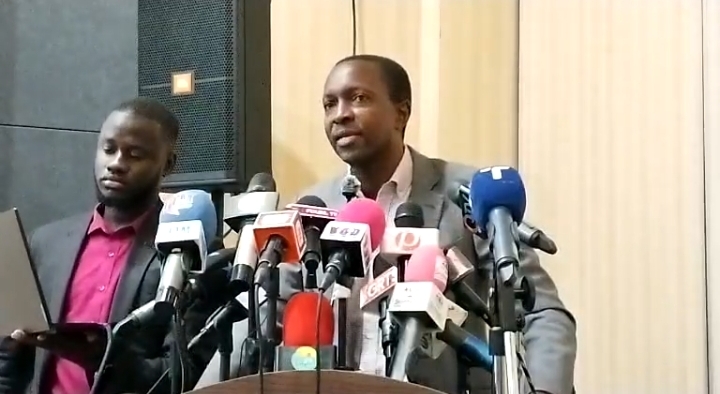
Amid the persistent power crisis that left many businesses and households struggling in the Greater Banjul Area, the National Water and Company (NAWEC) on Wednesday linked the weeks-long prolonged power blackouts to a combination of global fuel supply disruptions, technical faults, ongoing maintenance works, and delays in the arrival of new power generation machines purchased from Middle East, Dubai.
The state-owned company’s senior officials made the remarks during a press conference convened by the Ministry of Information, Media and Broadcasting Services at Sir Dawda Kairaba Jawara International Conference Centre.
Speaking to journalists on the crisis, the Deputy Managing Director of NAWEC, Mr. Sompou Ceesay has offered apologies to consumers and the general public, while maintaining that the company will ensure it sticks to the two-week stipulated timeline to return the electricity supply to normalcy.
He dismissed claims that the crisis are as a result of negligence or pending outstanding financial obligations between the Gambia and its external suppliers in Senegal and OMVG partners.
Ceesay noted that while frustrations are growing, NAWEC had already spent 1 million US Dollars from its own resources over the past twelve months and are expecting to spend another 2 million US Dollars on maintenance and rehabilitations next year.
As part of the plans to improve electricity, Mr. Ceesay announced plans to improve the electricity supply through a new 50-megawatts solar power in Jambur and a rapid recovery program for another 50-megawatts of generation capacity.
Prolonged power blackouts have already caused damages to businesses who extensively rely on electricity, with many households struggling to preserve their foodstuffs since the electricity crisis begin in the month of April.
According to Mr. Saidy, the ongoing conflict involving the United States, Israel and Iran has severely affected the global fuel market, leading to shortages and rising fuel prices for countries dependent on heavy fuel oil for electricity generation.
“The problem we are facing today is not only a Gambian problem. It is a global energy problem,” he told reporters, adding that the conflict has disrupted international supply chains and increased operational costs for utility providers across the region.
NAWEC officials disclosed that the utility currently relies heavily on imported electricity through the OMVG regional power network, while local generation plants continue to struggle with limited capacity and aging machines.
Operations and Planning Manager Sanna Gomez revealed that the country’s available electricity generation stands at around 78 megawatts, while national demand has exceeded 100 megawatts, creating a major supply deficit.
He explained that several generators at the Kotu and Brikama power stations are currently undergoing maintenance, forcing the company to implement load shedding to prevent a complete nationwide blackout.
“We have to remove some feeders from the system to stabilize the network. Otherwise, the entire grid could collapse,” Gomez said.
The officials further disclosed that NAWEC had purchased additional generators from Dubai in an effort to improve electricity supply. However, the shipment has reportedly been delayed because of disruptions linked to the US-Iran conflict and regional logistical challenges affecting international transportation routes.
Deputy Managing Director Sonko Ceesay said the war has not only affected fuel prices, but has also delayed the shipment of critical spare parts and equipment needed for maintenance works in The Gambia.
“The supply chain has been seriously disrupted. Spare parts and machinery are taking much longer to arrive,” he explained.
NAWEC said engineers are working around the clock to restore some engines currently under maintenance and expressed hope that generation capacity would improve within the coming weeks.
Despite the assurances, the company warned that load shedding could continue for an extended period if the global energy crisis persists and electricity imports remain unstable.
The prolonged outages have triggered frustration among households and businesses across the country, with many residents complaining about damages to electrical appliances, water shortages, and rising costs of operating private generators.
Several business owners in the Greater Banjul Area said the blackouts are affecting productivity and causing financial losses, especially for cold storage operators, tailors, internet cafés and small-scale food vendors.
NAWEC apologized to customers for the inconvenience and appealed for public patience as efforts continue to stabilize the national electricity network.